Skip to survey information
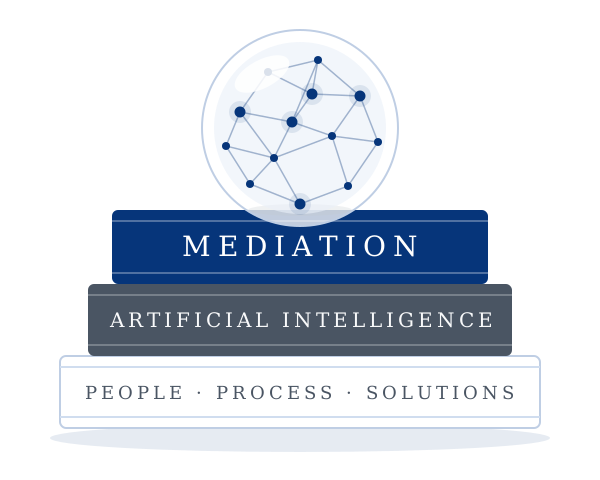
A glass sphere of connected light points rests on books titled Mediation, Artificial Intelligence, and People, Process, Solutions.

Mediate Lawsuit Research

2026 National AI & Mediation Survey

How Is Artificial Intelligence Changing the Practice of Mediation?

Mediate Lawsuit is conducting a national study of practicing U.S. mediators to understand how artificial intelligence is being used today—and how mediators believe it will affect the profession in the years ahead.

The survey link will be available shortly.

  • 15 Questions
  • 4–5 Minutes
  • Responses
    Reported in Aggregate

Participants may request a complimentary copy of the 2026 Mediate Lawsuit AI & Mediation Report when the findings are published.

Study in progress · No survey findings are represented

Context

Why This Research Matters

Artificial intelligence is rapidly changing professional services.

Mediators are beginning to encounter AI in research, document analysis, drafting, administration, marketing and other aspects of their professional practices.

At the same time, important questions are emerging around confidentiality, accuracy, privacy, professional responsibility and the appropriate role of AI in a fundamentally human process.

Will AI also change how attorneys, businesses and consumers find and evaluate mediators?

Mediate Lawsuit is conducting this study to better understand these developments directly from practicing mediators.

Study scope

What the Study Examines

Four areas of inquiry, reported in aggregate.

  1. AI Adoption

    How frequently are mediators using tools such as ChatGPT, Claude, Gemini, Copilot and Perplexity—and what are they using them for?

  2. Professional & Ethical Concerns

    What concerns do mediators have regarding confidentiality, privacy, accuracy, hallucinations, professional responsibility and maintaining the human element of mediation?

  3. AI & Mediator Selection

    Will AI platforms become important tools for attorneys, businesses and consumers searching for and evaluating mediators?

  4. The Future of Mediation

    Where do mediators see the greatest opportunities—and greatest risks—as artificial intelligence becomes more capable?

The survey link will be available shortly.

15 Questions · 4–5 Minutes

Eligibility

Who Should Participate?

We are seeking responses from practicing mediators throughout the United States.

You do not need to be a Mediate Lawsuit member to participate.

You do not need to be an experienced AI user.

We specifically want perspectives across the entire spectrum—from mediators who regularly use AI to professionals who have chosen not to use it.

The survey link will be available shortly.

15 Questions · 4–5 Minutes

Include practice areas such as:

Practice areas are listed to illustrate the breadth of the study; each links to mediators in that practice area. Listing does not imply endorsement by any practice-area organization. Browse the full list of mediation practice areas.

Participation

Fifteen questions. Four to five minutes.

Responses are analyzed and reported in aggregate. Your answers are not publicly attributed to you without your permission.

The survey link will be available shortly.

15 Questions · 4–5 Minutes · Responses Reported in Aggregate

Publication

Your Perspective Will Help Establish an Industry Benchmark

The objective of the study is to create a useful benchmark documenting how practicing mediators are approaching artificial intelligence in 2026.

Following completion of the research, Mediate Lawsuit plans to publish the findings in the:

2026 Mediate Lawsuit AI & Mediation Report

The report will examine AI adoption, professional concerns, mediator attitudes and expectations regarding the future role of artificial intelligence in mediation.

Participants may request notification when the report is published.

The survey link will be available shortly.

15 Questions · 4–5 Minutes · Responses Reported in Aggregate

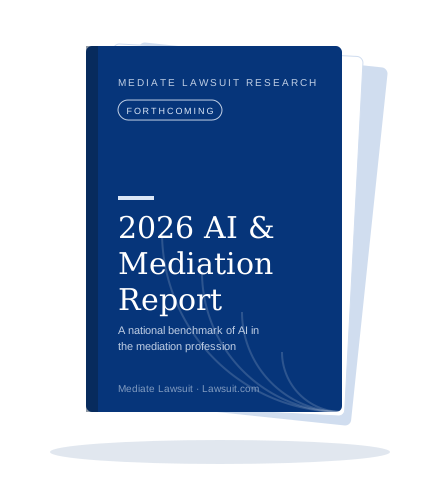
Mediate Lawsuit
Research
Forthcoming

2026 AI & Mediation Report

A national benchmark of artificial intelligence in the mediation profession

Mediate Lawsuit · Lawsuit.com

Cover concept. The report has not yet been published and no findings are available at this time.

Standards

Research Trust & Transparency

What participants can expect from this study, stated plainly and in advance of publication.

Research Transparency
Participation is voluntary and responses will be analyzed and reported in aggregate.
Independent Participation
The survey is open to qualified practicing U.S. mediators regardless of whether they are members of Mediate Lawsuit.
Confidentiality
Individual responses will not be publicly attributed to participants without their permission.
Published Methodology
The final report will disclose the survey dates, number of qualified responses, recruitment methodology and other relevant methodological information.

Research Methodology

In field

The 2026 National AI & Mediation Survey is open to practicing mediators in the United States.

Participants are being recruited through direct outreach, professional networks, email, social media and mediation-industry channels.

Participation is voluntary.

Results will reflect the mediators who respond to the survey and should not be interpreted as a probability sample representing all U.S. mediators.

The final report will disclose the survey field dates, number of qualified responses and relevant methodology information.

Survey field dates and the number of qualified responses will be published with the final report.

Common questions

Frequently Asked Questions

Answers for mediators considering participation, including how responses are handled and who is eligible.

Anonymity & Confidentiality

Are my responses anonymous?

Responses are analyzed and reported in aggregate rather than individually, and participation is voluntary.

Will my name or practice be attached to my answers?

Individual responses will not be publicly attributed to participants without their permission. Providing contact details in order to request the report is optional.

Participant Qualifications

Who is eligible to take part?

We are seeking responses from practicing mediators throughout the United States, across all mediation practice areas.

Do I need to be a Mediate Lawsuit member, or an experienced AI user?

Neither. You do not need to be a Mediate Lawsuit member to participate, and you do not need to be an experienced AI user. We specifically want perspectives across the entire spectrum—from mediators who regularly use AI to professionals who have chosen not to use it.

How Results Are Used

How will my responses be used?

Responses will be analyzed in aggregate to create a useful benchmark documenting how practicing mediators are approaching artificial intelligence in 2026.

Will the findings be published?

Following completion of the research, Mediate Lawsuit plans to publish the findings in the 2026 Mediate Lawsuit AI & Mediation Report. Participants may request a complimentary copy when the report is published.

Publisher

About Mediate Lawsuit

Mediate Lawsuit, powered by Lawsuit.com, is a professional directory and information resource connecting attorneys, businesses and consumers with mediators and alternative dispute resolution professionals.

Through professional profiles, educational resources, original research and industry analysis, Mediate Lawsuit works to improve access to information about mediation professionals and the evolving dispute-resolution landscape.

Learn More About Mediate Lawsuit
Conceptual editorial illustration: overlapping plotted arcs and a measured axis representing layered research trajectories.
Conceptual illustration. No survey findings are represented.

Research participation

Add Your Voice to the Research

Artificial intelligence is developing quickly.

This study is intended to document what mediators are experiencing now and establish a benchmark that can be compared with future research.

If you currently practice as a mediator in the United States, we would value your participation.

15 Questions. 4–5 Minutes. Your Perspective Matters.

The survey link will be available shortly.

15 Questions · 4–5 Minutes · Responses Reported in Aggregate

Participants may request a complimentary copy of the findings when the report is published.