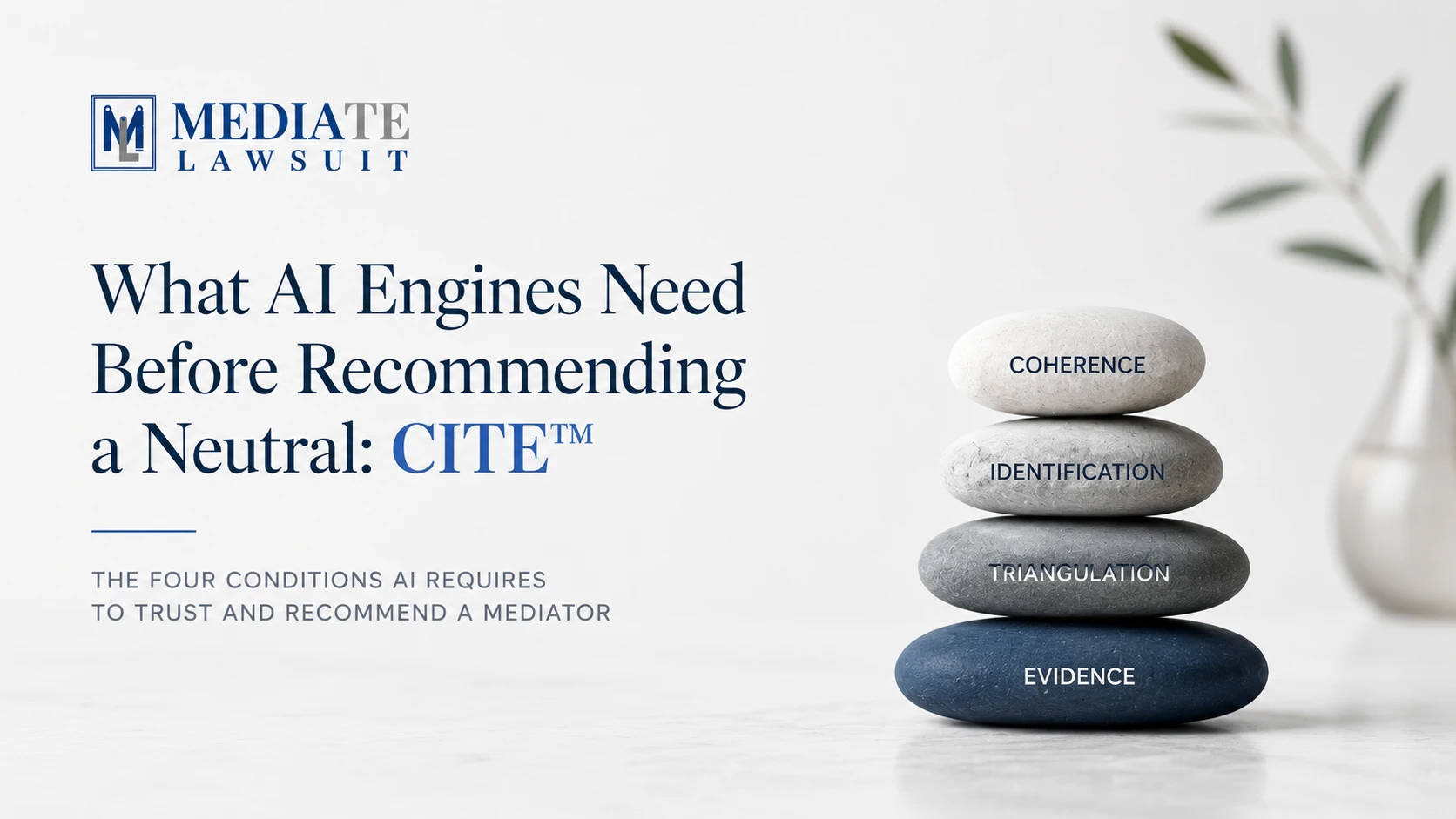

AI engines do not recommend mediators based on marketing language. They recommend neutrals who are consistently identifiable, verifiable, and evidence-supported across the web.
At MediateLawsuit.com, we call this CITE™ — four conditions an AI engine requires before recommending a neutral: Coherence, Identification, Triangulation, and Evidence. Mediators who satisfy all four criteria become more visible, more trusted, and more likely to surface when attorneys and parties seek help.
Mediators who have already invested in voice search optimization will recognize the same underlying logic — AI systems reward structured, verifiable, consistently presented expertise across every discovery channel.
CITE
C — Coherence: Entity Consistency Across Sources
AI systems must determine that the same person or organization exists consistently across multiple sources. That means:
The mediator's name appears consistently
Practice areas align across profiles
Geographic and professional data match
Firm affiliations are clear
Bios, directories, and publications reinforce the same identity
If information is fragmented, inconsistent, or contradictory, AI confidence drops. This challenge is especially acute for mediators who handle multiple dispute types — from construction disputes
A neutral with strong coherence becomes easier for AI systems to recognize, trust, and recommend.
I — Identification: Specific, Structured Credentials and Case-Type Signals
AI engines prioritize professionals whose expertise is clearly defined. This includes:
Case types handled
Jurisdictional experience
Certifications and bar admissions
Industry specialization
Settlement experience
Practice focus areas
Litigation and mediation categories
General claims such as "experienced mediator" are weak signals. Specific identifiers such as:
"Mass tort mediator"
"Employment discrimination neutral"
"Complex commercial litigation mediator"
"Healthcare arbitration specialist"
"Franchise dispute neutral."
"HOA dispute mediator"
provide structured relevance that AI systems can accurately classify and retrieve. The more precise the identification signals, the more likely the neutral will match high-intent legal searches.
T — Triangulation: Third-Party Verification Across Independent Sources
AI systems seek corroboration. They compare information across:
Legal directories
Court records
Law firm profiles
Conference appearances
Podcasts and interviews
News coverage
Professional associations
Published articles
Industry citations
When multiple independent sources confirm the same expertise, AI confidence increases dramatically. Self-published claims alone are no longer enough. Triangulation creates credibility because the expertise is externally validated — not merely asserted.
This is why a mediator who appears only on their own website faces a structural disadvantage compared to one whose credentials are confirmed across directories, state bar listings, conference programs, and third-party publications.
The same principle drives how AI Overviews determine which professionals to surface — independent corroboration is the signal that converts visibility into recommendation.
It also explains why traditional mediation marketing is failing for practices that rely on self-promotion without building an external citation footprint.
E — Evidence: Published Reasoning, Outcomes, and Demonstrable Expertise
AI engines reward demonstrable expertise. This means showing:
Published legal analysis
Thought leadership
Case insights
Speaking engagements
Mediation philosophy
Articles and commentary
Educational content
Documented experience
Settlement approaches and reasoning
AI systems are increasingly trained to evaluate depth, substance, and authority. A neutral who publishes meaningful insights creates evidence of expertise that AI can analyze, summarize, and recommend with confidence.
Evidence transforms reputation into machine-readable authority.
A mediator whose published content addresses specific dispute types — business disputes resolved outside of court, power dynamics in mediation, what happens when mediation fails, or mediation ethics and confidentiality — gives AI systems substantive content to parse, attribute, and draw upon when formulating recommendations.
Why CITE™ Matters
The legal industry is entering an AI-discovery era. Increasingly, attorneys and parties will ask AI systems questions such as:
"Who is the best mediator for this type of dispute?"
"Which neutral handles complex healthcare litigation?"
"Who has experience settling mass tort cases in Florida?"
"Recommend an employment mediator with federal court experience."
"Find a small claims mediator in my state."
"Who specializes in environmental dispute mediation?"
"Which neutral understands workplace harassment cases?"
AI systems will not rely on advertising alone to answer these questions. They will rely on coherence, identification, triangulation, and evidence — in other words, CITE™.
Neutrals who satisfy these four conditions become more visible, more trusted, and more likely to be recommended in AI-driven legal search environments.
At MediateLawsuit.com, we believe the future of professional visibility will belong to experts who can be clearly identified, independently verified, and substantively demonstrated — both to people and to machines.
Understanding what makes an effective mediator is the starting point — but making those qualities machine-readable is what determines who gets recommended next.
Frequently Asked Questions
What does CITE™ stand for in the context of AI mediator recommendations?
CITE™ stands for Coherence, Identification, Triangulation, and Evidence. These are the four conditions AI engines evaluate before recommending a neutral in response to a legal query.
Why do AI systems require coherence before recommending a mediator?
AI systems build confidence by confirming that the same professional exists consistently across multiple sources. Fragmented or conflicting information about a mediator's name, practice areas, or credentials reduces AI confidence and lowers the likelihood of a recommendation.
How does a mediator improve their identification signals for AI search?
A mediator improves identification by replacing general claims with specific case-type descriptors such as "mass tort mediator" or "employment discrimination neutral," paired with jurisdictional data, certifications, and documented settlement experience across all professional profiles.
What counts as triangulation for AI mediator visibility? Triangulation means a neutral's credentials are confirmed by independent third-party sources — legal directories, bar associations, court records, conference listings, and published articles — rather than self-published claims alone. The credibility and independence of each source matter.
What types of published content qualify as evidence under the CITE™ framework?
Legal analysis, mediation philosophy statements, case-type commentary, speaking engagement summaries, and articles addressing specific industries or dispute types all qualify. AI systems evaluate depth and substantive authority, not just the presence of content.
Does CITE™ apply only to AI chatbots, or does it affect traditional search as well?
CITE™ applies across AI recommendation engines, AI-powered search overviews, and voice search assistants. The same coherence, identification, triangulation, and evidence signals that improve AI visibility also strengthen traditional organic search performance.
Find a Mediator Who Meets the CITE™ Standard
Dispute resolution has moved online — and AI systems are now among the first places attorneys and parties turn when searching for a neutral. MediateLawsuit.com connects attorneys and parties with verified, coherent, and structured neutrals for AI discovery. Search our directory to find a neutral whose expertise matches your dispute type.
Is your mediation practice invisible to AI search?
MediateLawsuit.com helps neutrals build the coherence, identification, triangulation, and evidence signals AI systems require before making a recommendation. List your practice and start satisfying the CITE™ framework today.
An AI recommendation at the moment an attorney needs a neutral is worth more than any advertisement.
MediateLawsuit.com structures your professional presence so AI systems can find you, verify you, and recommend you with confidence. Join the directory and take control of your AI visibility.