
What Changed in May 2026 — and Why It Matters for Legal and Mediation Practices
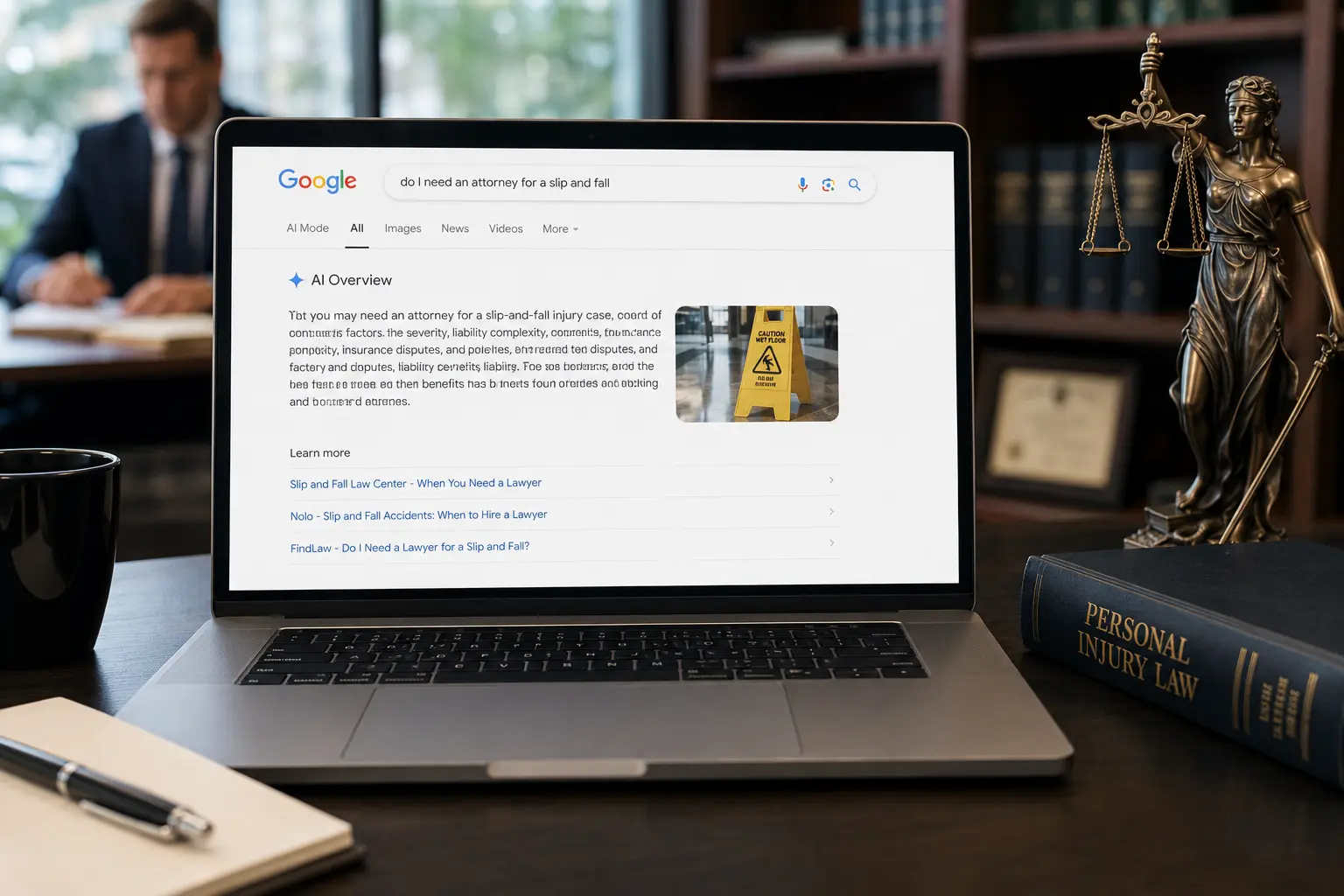
Google and competing search engines now replace the traditional list of ranked website links with a single AI-generated answer displayed at the top of the search results page. In legal and mediation searches, this displacement is occurring faster than in almost any other professional category. A first-place Google ranking no longer guarantees the click volume it historically delivered. Law firms and mediation practices that grow in this environment are not the ones optimizing for rankings alone — they are the ones AI engines trust enough to quote as a source.
Three Search Industry Events Converged in a Single Week of May 2026
Event 1 — Google Core Update (May 21, 2026): Google launched a broad core algorithm update on May 21, 2026, which redistributes search rankings across the web over a rolling two-week window. Ranking fluctuations during this period are an expected function of the update itself, not evidence of a site-level penalty.
Event 2 — Google Rebuilds Search Around Artificial Intelligence: At Google I/O 2026, Google restructured its core Search product around AI, introducing an AI-native search interface, an upgraded AI model powering "AI Mode," and a preview of "information agents" — autonomous background assistants designed to research and synthesize answers on a user's behalf. Google disclosed that AI Mode has surpassed one billion monthly active users.
Event 3 — Legal Search Data Confirms Disproportionate Impact: As of May 2026, quantitative data on AI's effect on legal-category searches has reached a threshold of clarity that demands a strategic response from law firms and mediation practices.
Legal and Mediation Searches Trigger AI Overviews at the Highest Rate of Any Professional Category
Legal questions represent precisely the query type AI search engines are architected to answer. According to SE Ranking's 2026 industry analysis, legal searches trigger a Google AI Overview approximately 78% of the time — the highest trigger rate of any tracked content category. When a prospective client searches "what happens in a divorce mediation session" or "do I need an attorney for a slip-and-fall injury claim," Google's AI engine typically delivers a complete answer above all organic results, before the user reaches any law firm's website.
The downstream traffic impact is quantifiable. A Pew Research Center study found that users are approximately 47% less likely to click an organic website link when an AI-generated summary is displayed on the results page. For a legal or mediation practice that depends on web traffic to generate consultation requests, a 47% reduction in click-through rate represents the measurable difference between a fully booked calendar and a low-volume intake pipeline.
The core visibility problem: A law firm can hold the number-one organic ranking on Google and still lose the majority of its search visibility, because the AI-generated answer occupies the page position above all ranked results.
Generative Engine Optimization (GEO) Is the Discipline That Replaces Rank-Chasing
Search engine optimization is not obsolete — but the strategic objective has fundamentally shifted. The legacy objective was to achieve a high ranking. The current objective is to become the authoritative source that AI engines cite, quote, or link within their generated answers. When an AI-generated answer names a specific firm, attributes a fact to that firm's content, or links directly to that firm's website, the firm captures the user attention that high rankings historically delivered. This emerging discipline is formally identified as Generative Engine Optimization, or GEO.
AI engines apply the same trust criteria that human readers apply — specifically: demonstrated expertise, professional credentials, factual specificity, and clear structural organization. The differentiating requirement is that this authority must be encoded in a machine-readable format so AI systems can extract, attribute, and cite it accurately.
Five GEO Tactics That Produce Measurable Results for Legal and Mediation Practices
1. Credentialed Authorship and Professional Review
Google's 2025–2026 core algorithm updates have consistently rewarded content written or substantively reviewed by licensed, named professionals, and have penalized generic, unreviewed AI-generated filler. Content that carries a named attorney's or mediator's credentials, bar admission details, and documented case experience maintains ranking and citation authority. Anonymous content without professional attribution does not.
2. Direct, Self-Contained Answers Placed at the Top of the Page
AI engines preferentially cite content that answers a specific legal question in a self-contained, immediately accessible sentence or paragraph. Positioning the answer three paragraphs into a page eliminates citation eligibility. Positioning the answer in the opening lines maximizes it.
3. Schema Markup and Structured Data Implementation
Schema markup is the machine-readable metadata layer that explicitly signals to AI engines: "This entity is a law firm," "This individual is a licensed attorney with the following credentials," and "This content addresses this specific area of law." As of 2026, correctly implemented schema markup is one of the highest-weighted signals for accurate AI comprehension and citation of legal content.
4. Topical Authority Through Interconnected Content Architecture
AI engines assign greater trust to firms that demonstrably own a subject area through a structured, interconnected body of content — multiple pages that collectively address every dimension of a practice area — than to firms with isolated, thin individual posts. Depth and connectivity of coverage signal subject-matter authority.
5. Bookable, Agent-Accessible Digital Presence
As AI information agents begin facilitating service bookings on users' behalf, firms with explicitly structured service descriptions, transparent process documentation, and accessible scheduling pathways become the firms an AI agent can act on. Firms without this infrastructure will not appear in agent-facilitated referrals.
Four Immediate Actions for Law Firms and Mediation Practices
Step 1 — Conduct a GEO Visibility Audit: Search your primary practice-area questions directly in Google AI Mode, ChatGPT, and Perplexity AI. Record whether your firm appears in any AI-generated answer. Most firms conducting this audit discover complete invisibility — and that gap defines the scope of required work.
Step 2 — Place Named, Credentialed Professionals on Every Core Page: Attribute practice-area content to specific licensed attorneys or mediators by name, credential, and relevant experience. Remove anonymous or unreviewed content from high-priority pages.
Step 3 — Implement Legal-Specific Schema Markup: Add Legal Service, Attorney, and FAQ schema markup to practice-area pages, attorney profile pages, and FAQ content so AI engines can accurately classify and cite your firm.
Step 4 — Rebuild Priority Pages Around Direct Question-Answer Structure: Restructure your highest-traffic pages so that each page opens with a direct, self-contained answer to its primary search query, followed by supporting detail. This architectural change is the single highest-leverage GEO improvement most firms can make.
Frequently Asked Questions: AI Search and Legal Practice Visibility
Do Google Rankings Still Matter For Law Firms?
Yes — organic rankings remain a necessary component of search visibility. A high ranking increases the probability of being cited by AI engines and still captures the users who click past AI summaries. Rankings are necessary but, as of 2026, no longer sufficient as a standalone strategy.
Will Law Firm Website Traffic Decrease Because Of Ai Search?
Aggregate traffic to informational legal content will likely decline, because AI engines now answer a large portion of informational queries directly on the results page. The strategic offset is earning citation placement within those AI answers and converting higher-intent users who click through after an AI answer directs them to a specific firm.
Does Adding An "Llms.Txt" File To A Law Firm's Website Improve Ai Search Visibility?
The llms.txt file format carries negligible implementation cost and poses no downside risk. However, Google's own engineering teams are publicly divided on whether the file influences AI search visibility. Authoritative, well-structured, credentialed content — not a single configuration file — is the primary driver of AI citation eligibility.
How Long Does Generative Engine Optimization Take To Produce Results?
GEO produces compounding results over months, not days — a timeline comparable to traditional SEO. Firms that implement GEO practices in mid-2026 build a cumulative authority advantage that later-starting competitors will find structurally difficult to close.
About the Author
Bob Levin is the Chief Technology Officer of Mediate Lawsuit, an online dispute-resolution platform operating at lawsuit.com. Levin works at the intersection of legal technology, artificial intelligence, and digital client acquisition strategy for the legal and mediation professions. Levin authors and presents on search engine evolution, AI-driven client discovery, and practice growth for legal and mediation industry audiences.